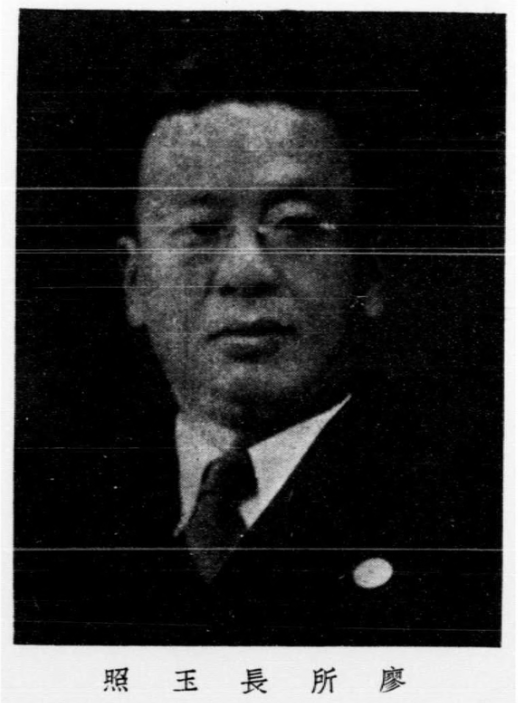
Agronome anticommuniste et francophile au parcours sinueux originaire de Jiading 嘉定 (Jiangsu), Liao Jianan, connu également sous le nom de Liao Nancai 廖南才, effectue ses études en France à l’Institut national agronomique (« l’Agro »). Membre du GMD, chargé de la question paysanne au sein du bureau provincial du Jiangsu, Liao prend, en 1927, la tête de l’École d’agriculture de Suzhou (Suzhou nongye xuexiao 蘇州農業學校). L’installation cette même année du Gouvernement national à Nankin s’accompagne d’une réorganisation profonde de l’enseignement supérieur. Liao participe au débat houleux qui accompagne cette réforme. Menée par Cai Yuanpei 蔡元培 (1868-1940) à la tête de l’Institut universitaire (Daxueyuan 大學院), qui remplace le ministère de l’Éducation, elle consiste à organiser les établissements en académies dépendant d’une université suivant le modèle français. En août 1927, l’École d’agronomie n°2 du Jiangsu (Jiangsu shengli di-er nongye xuexiao 江蘇省立第二農業學校) est ainsi placée dans l’académie de l’Université Sun Yat-sen n°4 (Di-si Zhongshan daxue 第四中山大學), rebaptisée Université du Jiangsu (Jiangsu daxue 江蘇大學), puis Université centrale (Zhongyang daxue 中央大學) en 1928. Avec d’autres directeurs d’établissements du Jiangsu, Liao pétitionne auprès du président de l’Université centrale, Zhang Naiyan 張乃燕 (1894-1958) à ce sujet, tout en se désolidarisant des protestataires. Finalement, la réforme est abrogée en 1929, victime des luttes intestines à la tête du GMD. Liao doit lui-même faire face à des luttes au sein de son propre établissement. Le 31 octobre 1930, les étudiants de l’École d’agriculture de Suzhou refusent de poursuivre les cours, exigeant le départ du directeur des études, Dai Qixiang 戴起祥. En dépit de la démission de ce dernier et de l’intervention des autorités locales, la colère des étudiants ne faiblit pas. Il apparaît finalement que l’affaire était une manipulation ourdie par le directeur de la discipline chargé d’enseigner la doctrine du Parti, Pan Tianjue 潘天覺, dans le but d’obtenir le poste de Dai. Démasqué, Pan se réfugie dans le bureau local du GMD, ce qui provoque le lancement d’une enquête au niveau des instances provinciales.
Parallèlement à l’enseignement des techniques agricoles modernes au sein de son école, Liao Jianan s’implique dans leur mise en pratique à travers des projets s’inscrivant dans le « mouvement de reconstruction rurale » (nongcun jianshe yundong 農村建設運動). Initié par des réformateurs tels que Liang Shuming 梁漱溟 (1893-1988) et Yan Yangchu 晏陽初 (1893-1990), ce mouvement ne vise pas seulement à moderniser les campagnes, mais participe d’une réflexion plus large sur le sens de la modernité elle-même en encourageant la jeunesse urbaine à opérer un retour à la terre. Il prend la forme de projets distincts visant à développer des villages modèles. Au début des années 1930, ce mouvement est en partie récupéré par le parti-État nationaliste, qui cherche à étendre son influence dans les zones rurales en développant des zones expérimentales, telles que celle gérée par Mei Siping à Jiangning. Décidé à piloter sa propre expérimentation, Liao consulte deux personnages incontournables à Suzhou, dont il est proche : l’ancien bras droit de Yuan Shikai, Zhang Yilin 張一麐 (1867-1943), et Li Genyuan 李根源 (1879-1965), un vétéran de la Ligue jurée. Avec leur appui, il initie le projet du « Nouveau village de Shanrenqiao » (Shanrenqiao xincun 善人橋新村) situé à 18 km au sud-ouest de Suzhou. En février 1930, la Société chinoise de l’enseignement professionnel (Zhonghua zhiye jiaoyu she 中華職業教育社) crée officiellement la « Zone de progrès rural de Shanrenqiao » (Shanrenqiao nongcun gaijin qu 善人橋農村改進區) en coordination avec les autorités locales. Outre Liao, Zhang Yilin et Li Genyuan, le comité préparatoire compte des personnalités de premier plan telles que Cai Yuanpei, Huang Yanpei 黄炎培 (1878-1965), Hu Shuhua 胡庶華 (1886-1968) et Jiang Jianyu 江間漁. Le projet est encadré par des poids lourds de la Société chinoise de l’enseignement professionnel tels que Huang Yunshen 黃蘊深 (1872-1953), alors magistrat du district de Wuxian (Suzhou), Pan Wen’an 潘文安 (1894- ?) et Yao Huiquan 姚惠泉 (1895-1988). Financé pour partie par l’administration de district, le projet doit durer trois ans, période à l’issue de laquelle les paysans de la zone expérimentale sont censés devenir triplement autonomes : ils doivent pouvoir se gouverner par eux-mêmes (zizhi 自治), être autosuffisants (ziji 自給) et assurer leur propre protection (ziwei 自衛). Suivant les préceptes de l’ « éducation des masses » (minzhong jiaoyu 民眾教育), plusieurs établissements scolaires sont créés, de même qu’une bibliothèque ou encore une « maison de thé des masses » (minzhong chayuan 民眾茶園). La diffusion auprès des paysans des techniques agricoles modernes est assurée par une quarantaine d’experts sous la houlette de Liao Jianan. Elle n’est pas sans susciter des résistances de la part des intéressés. La première tâche à laquelle s’attellent les hommes de Liao consiste à remplacer les latrines à ciel ouvert, qui jalonnent les chemins, par des pièces à compost (duifeishi 堆肥室), afin d’améliorer l’hygiène et de mettre en valeur les excréments. Si le « Nouveau village de Shanrenqiao » partage les objectifs du mouvement de reconstruction rurale, ainsi qu’un certain paternalisme vis-à-vis des paysans, il contribue toutefois moins à renforcer une véritable autonomie locale que l’emprise de l’État nationaliste en organisant à son profit la police locale. Durant ces années, Liao est régulièrement amené à traiter avec le chef du Bureau de l’éducation du gouvernement provincial du Jiangsu, Zhou Fohai, et avec celui des Travaux publics, Dong Xiujia.
À l’automne 1933, Liao Jianan démissionne de son poste de directeur de l’École d’agriculture de Suzhou pour occuper des fonctions dans les instances centrales du GMD à Nankin (Zhongyangbu 中央部) à la tête d’un « groupe sur l’agriculture » (Nongyezu 農業組) créé en 1936. Il pilote des chantiers de défrichage de grande ampleur, au nord du Jiangsu, dans les districts de Haizhou 海州 et Guanyun 灌雲. Parallèlement à la poursuite de ses activités dans le domaine rural, Liao prend, en novembre 1935, la direction de l’Institut de rééducation de la capitale (Shoudu fanxingyuan 首都反省院), qui voit officiellement le jour l’année suivante. Nommé à l’essai, Liao est confirmé dans ses fonctions en juin 1937. Il s’agit de l’un des centres de détention mis en place entre 1929 et 1937 pour endoctriner les dissidents communistes arrêtés par les autorités nationalistes. Outre des cours d’idéologie, la rééducation des prisonniers politiques repentis passe notamment par le travail aux champs. Cette nomination laisse penser que Liao est proche de la Clique C.C. des frères Chen Guofu 陳果夫 (1892-1951) et Chen Lifu 陳立夫 (1900-2001), qui ont la haute main sur les services secrets civils du GMD chargés de traquer les communistes. En effet, bien que les instituts de rééducation dépendent en principe du ministère de la Justice (Sifa xingzheng bu 司法行政部), ils passent sous le contrôle de fait des services secrets du GMD en avril 1933. Comment expliquer que le directeur d’une école professionnelle en vienne à occuper une telle position ? Faute de réponse dans les sources, on peut émettre l’hypothèse que Liao est peut-être devenu proche de Chen Lifu après que celui-ci a été nommé à la tête du Comité agraire (Tudi weiyuanhui 土地委員會) créé en 1934 pour mener une vaste enquête préalable au lancement de la réforme agraire. On sait qu’il est, par ailleurs, bien introduit auprès des dirigeants provinciaux du Jiangsu, parmi lesquels le gouverneur Chen Guofu et Zhou Fohai. Durant son mandat à Nankin, Liao développe des liens avec Ju Zheng 居正 (1876-1951), président du Yuan judiciaire et l’un des dirigeants du groupe des Collines de l’Ouest (Xishan huiyi 西山會議). Située à l’extrême droite du GMD, cette faction a vu le jour en 1925, au lendemain de la mort de Sun Yat-sen, parmi les opposants au Front uni avec le PCC. Après la rupture sanglante de celui-ci en 1927, elle œuvre pour « nettoyer le Parti » (qingdang 清黨) des communistes. À cette fin, et avec l’appui de la Clique C.C., elle favorise la « partification » (danghua 黨化) de l’administration judiciaire et initie la mise en place des instituts de rééducation que Ju Zheng centralise. L’entrée en vigueur du second front uni au début de la guerre sino-japonaise met fin, pour un temps, à cette terreur blanche. Le 18 août 1937, Liao reçoit la visite de deux représentants du PCC, Zhou Enlai 周恩來 (1898-1976) et Ye Jianying 葉劍英 (1897-1986). Ils viennent s’enquérir de ses « pensionnaires », dont le nombre, leur explique Liao, est passé de 91 lors de sa prise de fonctions en 1935 à une dizaine seulement. Zhou Enlai s’inquiète en particulier du sort de trois militantes communistes : Wang Genying 王根英, épouse de Chen Geng 陳賡 (1903-1961) arrêtée en 1933 ; Xia Zhixu 夏之栩, veuve de Zhao Shiyan 趙世炎 (1901-1927), également tombée aux mains des Nationalistes en 1933 ; et Zhang Qinqiu 張琴秋, dirigeante militaire et veuve de Shen Zemin 沈澤民. Liao accepte la libération des deux premières mais refuse d’élargir Zhang Qinqiu, au motif qu’elle n’est pas une prisonnière politique, mais une prisonnière de guerre. Par conséquent, il exige l’autorisation préalable de Gu Zhutong 顧祝同 (1893-1987), qui l’a transférée à Nankin. Zhou Enlai demande à voir l’ensemble des prisonniers à qui il annonce l’accord passé entre le GMD et le PCC, leur promettant une libération rapide pour rejoindre le front. Après avoir fait signer à Zhou et Ye des formulaires par lesquels ils se portent garants des trois femmes, Liao libère celles-ci.
Après la fermeture de l’Institut de rééducation de la capitale, on perd la trace de Liao Jianan dans les sources de l’époque jusqu’en 1940. Les seules informations sur cette période se trouvent dans une longue lettre qu’il adresse en décembre 1949 à Ju Zheng dans laquelle Liao ne dit rien de son rôle en zone occupée. Selon son récit, après avoir rejoint Chongqing fin 1937, Liao est l’objet d’attaques et décide de ne pas se battre pour obtenir un poste. Il s’installe à Mengzi 蒙自, au Yunnan, où il prend la direction de l’École spéciale d’agriculture et de sylviculture (Nonglin zhuanke xuexiao 農林專科學校) gérée par le gouvernement provincial. Élu à la tête de l’Association chinoise pour la reconstruction rurale (Zhongguo nongcun jianshe xiehui 中國農村建設協會), il dirige un Groupe d’enquête sur l’activité économique dans les zones frontalières du Sud-Ouest (Xinan bianjiang shiye diaocha tuan 西南邊疆實業調查團), mais n’est pas en mesure de mener à bien cette entreprise en raison du manque de moyens et de personnels. Le récit enchaîne ensuite directement avec ses activités au lendemain de la victoire en 1945, laissant croire qu’il a passé la guerre au fin fond du Yunnan. Selon le témoignage de He Fangzhou 何芳洲, un jeune disciple de Liao au sein du « Nouveau village de Shanrenqiao », Liao se trouve à Hong Kong en 1940 où il rencontre par hasard Zhang Yilin. Les circonstances dans lesquelles il accepte de rallier le Gouvernement national réorganisé établi par Wang Jingwei à Nankin en mars 1940 ne sont pas connues, mais on sait que Hong Kong voit alors passer plusieurs cadres du Mouvement pour la paix. Le nom de Liao apparaît dans une liste non datée des « membres postulants du Comité central de contrôle » (Zhongyang jiancha weiyuanhui houbu weiyuan 中央監察委員會候補委員), c’est-à-dire un strapontin dans la plus faible des trois instances centrales du GMD « orthodoxe » formé par Wang Jingwei en août 1939. Le 7 juillet 1940, il est chargé de mission (gongshi zai bu banshi 公使在部辦事) au sein du ministère des Affaires étrangères (Waijiaobu 外交部), autrement dit un poste dénué de tout pouvoir. Liao a-t-il trop tardé avant de rallier le camp de la collaboration, ce qui expliquerait ces postes obscurs ? Il finit néanmoins par percer au printemps 1941 dans une administration qu’il connaît bien – celle du Jiangsu –, alors que le lancement de la campagne de pacification rurale (Qingxiang gongzuo 清鄉工作) en juillet est précédé par un renouvellement progressif du personnel provincial. En mai 1941, Liao est nommé à la tête du Département des travaux publics (Jiansheting 建設廳) et devient membre du comité provincial, où il retrouve Dong Xiujia. En octobre, il cumule également la direction du Bureau de gestion des vivres (Liangshi guanli ju 糧食管理局). Il est remplacé à ces deux postes dès mars 1942, tout en conservant son siège au comité provincial. Après la nomination de Li Shiqun comme gouverneur du Jiangsu en décembre 1941, l’administration provinciale fusionne avec celle de la Pacification rurale. Liao n’obtient pas de fonctions dans cette dernière, hormis comme membre du Comité préparatoire de l’Assemblée générale pour la commémoration du premier anniversaire de la Pacification rurale (Qingxiang zhounian jinian dahui choubei weiyuanhui 淸鄉週年紀念大會籌備委員會). Entre janvier et juin 1943, il sert comme vice-ministre des Travaux publics (Jianshebu cizhang 建設部次長) dans un ministère né, cette même année, de la fusion entre le Comité d’hydraulique (Shuili weiyuanhui 水利委員會) et le ministère des Communications (Jiaotongbu 交通部). Dans un entretien accordé à la presse au moment de sa prise de fonctions, Liao explique que, dans le cadre du « régime de guerre » (zhanshi tizhi 戰時體制), le nouveau ministère entend s’atteler à la reconstruction des infrastructures fluviales, routières et des PTT nécessaires au développement de l’économie et à la victoire dans la Guerre de la grande Asie orientale. Après ce bref passage à la tête d’un ministère, Liao est récompensé par un poste de conseiller en affaires politiques (zhengwu canzan 政務參贊) du gouvernement central, une sinécure créée à cette époque pour recaser les victimes méritantes des multiples remaniements.
Parallèlement à ces charges dans l’administration provinciale et centrale, Liao Jianan reste très actif dans le domaine de la reconstruction rurale. En mars 1942, il prend la direction de l’Institut central d’expérimentation agricole (Zhongyang nongye shiyan suo 中央農業實驗所) rattaché au ministère de l’Industrie (Shiyebu 實業部) dirigé par Mei Siping. Inauguré en janvier 1932 et dirigé un temps par Chen Gongbo, cet organisme a pour missions de réaliser des enquêtes sur le secteur agricole, de tester de nouveaux produits (semences, engrais, insecticides) et de former des experts aux nouvelles techniques agricoles. Déplorant que tous ces aspects aient été délaissés par le Gouvernement national réorganisé depuis son « retour à la capitale » en raison des crises multiples auxquelles il fait face, Liao peine à relancer l’institut. Il se plaint du manque de fonds, d’ouvrages, d’outils et de produits chimiques, ainsi que des difficultés à recruter du personnel qualifié – il emploie tout de même une centaine d’agronomes, auxquels s’ajoutent 140 paysans employés à l’année. L’institut gère également une École des apprentis paysans (Nongmin zidi xuexiao 農民子弟學校) en association avec le Nouveau village de Yanziji (Yanziji xincun 燕子磯新村). S’il obtient une forte augmentation des financements, celle-ci reste inférieure à l’inflation. Les bâtiments d’avant-guerre ayant été en grande partie détruits au début des combats, ils doivent être reconstruits. Sur les quelque 2600 mu (160 ha) de terres que possédaient l’institut dans les environs de Nankin en 1937, il ne dispose plus que d’environ 1000 mu ; le reste ayant été réquisitionné par l’« armée amie » pour y cultiver des plantes médicinales. L’institut emploie comme conseillers trois ingénieurs agronomes japonais passés par le ministère de l’Agriculture et des Forêts (Nōrin-shō 農林省) et détachés auprès du Kōa-in 興亜院 : Yamazaki Shōjirō 山崎昇二郎, Kawamata Koreyoshi 川又是好 et Iida Saichi 飯田左翼. Yamazaki a dirigé, entre 1921 et 1925, la Station d’expérimentation agricole du département de Hyōgo (Hyōgoken-ritsu nōji shikenjō 兵庫県立農事試験場) établie en 1894 à l’ouest de Kobe. Liao cherche à redonner à l’institut son rôle d’avant-guerre en obtenant, en août 1942, que soit rétabli le décret plaçant les différentes fermes expérimentales du pays sous son autorité scientifique. En 1943, au moment du lancement du « Mouvement d’augmentation de la production agricole » (Nongye zengchan yundong 農業增產運動) qui accompagne l’entrée en guerre de Nankin, Liao envoie des experts au Jiangsu, au Zhejiang et dans l’Anhui pour rationaliser la production. Nankin est désignée zone du riz non glutineux et du blé (xiandao xiaomai qu 秈稻小麥區), Suzhou celle du riz glutineux (jingdao qu 粳稻), Xuzhou celle du blé et du maïs (xiaomai yumi qu 小麥玉米區), Bengbu celle du soja (dadou qu 大豆區) et Nantong (Shanghai) celle du coton (mianzuo qu 棉作區).
Le rôle moteur de Liao Jianan dans l’organisation et la défense de la « reconstruction rurale » en Chine occupée passe également par l’Association chinoise pour la reconstruction rurale (Zhongguo nongcun jianshe xiehui 中國農村建設協會) que Liao refonde à Suzhou en août 1941. Dès octobre 1940, il réunit une dizaine de spécialistes de l’agriculture à Nankin dans l’idée d’obtenir la création d’une agence ad hoc avec le soutien du gouvernement. Les deux ministères avec lesquels il est alors en contact, celui de l’Agriculture et des Mines (Nongkuangbu 農礦部) et celui des Affaires sociales (Shehuibu 社會部), disparaissent lors du premier remaniement d’août 1941. Désormais en poste à Suzhou, Liao décide de faire aboutir son projet sous la forme d’une association qui compte une soixantaine de membres à sa création en août 1941, contre 380 deux ans plus tard. Présidée par Liao, elle est dirigée par des experts travaillant pour certains au sein de l’Institut central d’expérimentation agricoles tels que Lu Yitang 陸錫愓, Shao Younong 邵友農, Wang Fusheng 王復生, ou encore Gu Boming 顧伯明. Elle pétitionne auprès du gouvernement central pour que soient établies des écoles agricoles dans chaque district, une manufacture d’outils agricoles ou encore pour une augmentation du salaire des experts agronomes. En janvier 1943, l’association se dote d’une revue, le mensuel Nongcun jianshe 農村建設 (Reconstruction rurale) patronné par Chu Minyi, Mei Siping et Li Shiqun. Dès son deuxième numéro, la revue est touchée par les pénuries de papier, qui l’oblige à passer à une parution tous les deux voire trois mois. Liao y publie régulièrement des articles dans lesquels il met notamment en avant le modèle français. Selon son analyse, en favorisant un secteur agricole composé de nombreux petits propriétaires terriens la France est parvenue à relancer son économie après sa défaite contre la Prusse. Liao fait l’éloge d’un système agricole français alliant des organes spécifiques à chaque échelon de l’administration et un réseau de coopératives et de crédit agricoles, dans lequel travaillent des dizaines de milliers d’experts formés dans les écoles agricoles dont lui-même est issu. Il souhaite également que la Chine s’inspire de l’ordre du Mérite agricole français pour redonner au monde rural l’importance qu’il mérite. Bien qu’il s’agisse avant tout d’une revue spécialisée dans laquelle on peut lire des articles pointus, la ligne éditoriale n’est pas imperméable à la propagande pro-japonaise. Elle publie ponctuellement des textes sans rapport avec l’agronomie, tels que la traduction d’une allocution prononcée par le consul Horiuchi Tateki 堀内幹城 (1889-1951) lors d’un « camp d’entraînement pour fonctionnaires » (gongwuyuan jixunying 公務員集訓營) appelant le peuple chinois à dépasser son individualisme atavique pour développer son sens du sacrifice. Liao, lui-même, adapte son discours à l’air du temps. Dans un article publié en octobre 1943, il se réjouit ainsi qu’à la faveur de la Guerre de la Grande Asie orientale, les peuples est-asiatiques se soient « éveillés », mais critique l’influence persistante des « nouveaux intellectuels obsédés par la civilisation matérielle » qui, au nom des sciences occidentales modernes, méprisent la Chine rurale en ne jurant que par l’industrialisation des villes. À ses yeux, la modernisation de la Chine doit commencer par celle de son agriculture. Sa défense de la légitimité et des intérêts de sa profession l’amène à critiquer à demi-mot le régime de Nankin. En décembre 1943, il dénonce ainsi les « beaux discours sur l’augmentation de la production [增產八股] », appelant à agir plutôt qu’à parler, alors que le ministre des Vivres, Gu Baoheng, vient de réunir le 15 octobre un Conseil national pour la promotion de l’augmentation de la production vivrière (Quanguo liangshi zengchan cejin huiyi 全國糧食增產策進會議). Alors qu’il estime la surface des terres en friches aux Jiangsu, Zhejiang et Anhui à 3 793 009 mu, il déplore le manque de personnels qualifiés pour encadrer leur exploitation. Citant la formule « il faut dix ans pour élever un arbre, mais cent ans pour élever un peuple [十年樹木,百年樹人 ] », Liao regrette que trop peu d’ingénieurs agronomes aient été formés par le passé. Sur le millier d’étudiants passés par l’École d’agriculture de Suzhou durant ses sept années comme directeur, une partie se sont, selon lui, reconvertis en raison des salaires trop bas auxquels peuvent prétendre ces experts, « bien inférieurs à celui d’un marchand ambulant ». Dans une Chine comptant de nombreux chômeurs, mais trop peu de personnes disponibles sachant cultiver la terre, Liao préconise l’organisation de stages de formation pour répondre à l’objectif d’« augmentation de la production ». Lors de la 3e assemblée générale de l’Association chinoise pour la reconstruction rurale en octobre 1943, Liao se félicite tout de même de la forte augmentation du nombre de structures agricoles privées qu’il explique par l’explosion des prix des produits agricoles, mais aussi par l’activisme de l’association, dont les membres participent à ces nombreuses entreprises.
Dans ce contexte, l’association décide de recentrer ses activités à Shanghai pour y mener ses projets éducatifs et d’expérimentation rurale. En janvier 1944, elle remet sur pied l’École spéciale d’agriculture de Shanghai (Shanghai nongye zhuanke xuexiao 上海農業專科學校), dont Liao prend la direction. Le conseil d’administration de l’école compte des personnalités notoires telles que le nouveau directeur du Shenbao, Chen Binhe, et certains des principaux hommes d’affaires de la ville comme Lei Xianzhi 雷顯之 (1898-1970), Shen Shi 沈世, Xiang Kangyuan 項康元, Xu Guanqun 許冠羣 (1896-1976), Xu Xiaochu 許筱初 (1898-1983), You Dao 尤島 et Zhu Boquan 朱博泉 (1898-2001). Ayant réuni un capital de 2 millions de yuans, Liao et d’autres membres du conseil d’administration de l’école font chacun un don personnel de 10 000 yuans pour financer l’ouverture de l’établissement. Dans le même temps, l’association de Liao lance le Nouveau village de Chensiqiao (Chensiqiao xincun 陳思橋新村) grâce à des subsides du gouvernement et avec l’aide de camarades « constructionnistes » déjà établis dans l’ouest de Shanghai au sein de la ferme de Jiafeng (Jiafeng nongchang 嘉豐農場). Il semble que l’École spéciale d’agriculture de Shanghai n’ait pas rencontré le succès escompté, puisqu’en juillet et août 1944, des annonces paraissent dans la presse shanghaienne annonçant un examen d’entrée ouvert à 30 étudiants, garçons et filles compris, pour l’École de la reconstruction rurale (Nongcun jianshe xueyuan 農村建設學院) dirigée par Liao. En janvier 1945, celui-ci décide de transférer l’établissement à Suzhou afin, explique-t-il, de permettre aux étudiants d’être plus proches de la campagne pour réaliser leurs travaux pratiques. Dans le même temps, l’Association chinoise pour la reconstruction rurale s’associe avec le gouvernement provincial du Jiangsu, dont le siège est à Suzhou, pour diriger la mobilisation de la population locale afin d’« augmenter la production ».
On perd ensuite de nouveau la trace de Liao Jianan, jusqu’en juillet 1948. Il est alors visé, aux côtés de Dong Xiujia et Cai Hongtian 蔡洪田 (1901-?), par un mandat d’arrêt émis par le Bureau du procureur de la Haute cour du Jiangsu (Jiangsu gaodeng fayuan jiancha chu 江蘇高等法院檢察處) contre ces trois anciens dirigeants de l’administration provinciale ayant disparu après la victoire. À en croire sa lettre de décembre 1949 à Ju Zheng, qui occulte totalement son rôle dans la collaboration, Liao décide au lendemain de la victoire de partir pour l’Europe. Désespéré, écrit-il, par la décadence du GMD et la corruption ambiante, il suit les conseils pressants de son ami, le consul français de Nankin Pierre Salade (1903-1990) – principal interlocuteur des membres francophiles du gouvernement de Wang Jingwei sous l’occupation. Liao se convainc qu’il sera plus utile à sa patrie en étudiant sur place la reconstruction des pays européens. Parti au printemps 1947, il séjourne en Angleterre, en France, en Belgique, en Suisse, en Italie et aux Pays-Bas, sans expliquer comment il finance un tel voyage. Comparant la situation économique, politique et diplomatique de ces pays, il se lamente que son propre gouvernement, « tout imbu de son statut de vainqueur, n’ait pas tenu compte des souffrances du peuple », conduisant à la montée en puissance des communistes, dont Liao suit, atterré, les progrès dans la presse européenne. Alors même, écrit-il, que ses amis l’exhortent à repousser son départ, Liao décide de rentrer en Chine en avril 1949, emportant avec lui le fruit de ses recherches, qu’il compte soumettre aux autorités centrales pour qu’elles en fassent bon usage. Liao ne dit rien dans sa lettre à Ju Zheng de la thèse de doctorat intitulée « Perspectives de l’économie rurale en Chine » (146 pages), qu’il soutient en 1949 sous le nom de Liao Nam-tse (Liao Nancai 廖南才) à la faculté de droit de l’Université de Paris.
Apprenant à son arrivée que la capitale est déjà perdue, Liao se rassure d’abord en pensant que le Gouvernement national contrôle encore Shanghai et un grand nombre de provinces. Devant la tournure que prennent les événements, il se hâte néanmoins d’embarquer pour Taiwan. En chemin, il croise son vieil ami Ge Jianshi 葛建時 (1896-1981), élu en 1947 à l’Assemblée nationale (Guomin dahui 國民大會). Les deux hommes se sont connus en 1927 au sein du bureau du GMD au Jiangsu. Enthousiasmé, selon lui, par le rapport que Liao souhaite transmettre au gouvernement, Ge l’encourage à écrire séparément à Jiang Jieshi et à Li Zongren 李宗仁 (1890-1969). Mais craignant que la poste n’égare son précieux travail, Liao le confie à Xu Enzeng 徐恩曾 (1896-1985), qui doit se rendre dans la capitale provisoire de Canton. Mal lui en prend : Xu perd les documents avant d’avoir pu les remettre (ou bien pour ne pas avoir à les remettre ?). Liao trouve un autre moyen de se faire valoir auprès des autorités. Alarmé que la population ne mesure par le danger que représente le PCC, il publie en novembre 1949 à Taipei une brochure sobrement intitulée Critique du communisme (Gongchan zhuyi pipan 共產主義批判) sous le pseudonyme de Liao Chunfeng 廖春風 – une référence à l’expression « brise printanière se transforme en pluie » (chunfeng huayu 春風化雨), métaphore des bienfaits de l’éducation. Il y déroule une critique très générale de la pensée marxiste, en n’abordant le cas de la Chine que dans les dernières pages, sans attaquer le PCC sur sa politique agraire. Outre ladite brochure, Liao gratifie Ju Zheng d’un long développement sur la diplomatie chinoise. Il dénonce la naïveté des États-Unis vis-à-vis du communisme et l’aide insuffisante apportée à la Chine, indiquant qu’il a écrit en mars 1948 au Président Truman pour l’exhorter à faire plus pour endiguer le communisme. Liao attaque au passage la responsabilité de l’entourage de Jiang Jieshi – Kong Xiangxi et la famille Song – dont la corruption notoire a irrémédiablement abimé l’image de la Chine en Occident ; critique alors répandue chez les soutiens historiques mais désillusionnés du Généralissime tels que Chen Lifu. Il reproche aux médias occidentaux de relayer la propagande du PCC présentant les communistes comme des tenants de la « réforme agraire » qu’il défend lui-même. Le plan miraculeux, dont Liao croit qu’il sauvera le régime nationaliste, prévoit notamment une révolution des traitements dans la fonction publique. À l’inverse des pays européens qui ont opéré des licenciements massifs après-guerre, Liao recommande de garder tous les fonctionnaires en leur versant un même salaire quel que soit leur échelon. Les agents désœuvrés pourront se consacrer à la propagande anticommuniste. Liao définit également sa grande idée en matière de relations internationales : les États-Unis n’étant pas un allié fiable, la Chine doit s’appuyer sur une « seconde ligne diplomatique [di-er waijiao luxian 第二外交路線] » en renforçant ses relations avec la Grande-Bretagne et surtout la France. La raison d’être de cette logorrhée apparaît dans les dernières lignes et elle est répétée dans une seconde lettre envoyée à Ju Zheng deux semaines plus tard : à défaut de pouvoir contribuer à la réforme agraire que le GMD n’a pas eu le temps de mettre en place en Chine, Liao laisse entendre qu’il serait le candidat idéal pour être envoyé en mission en Europe, afin de construire ladite « seconde ligne diplomatique ». Liao finit sa première lettre en précisant, dans le post-scriptum, qu’il a décidé de ne plus utiliser que son deuxième nom Nancai 南才 (« talent du Sud »). Si ce nom est parfois utilisé avant 1949, celui de Jianan disparaît totalement après cette date, signe que Liao cherche à effacer les traces de sa participation au gouvernement collaborateur de Wang Jingwei.
Sa carrière de diplomate ayant tourné court, Liao se rabat sur un domaine dans lequel il a davantage de compétences. En 1951, il cosigne un « Mémorandum pour la renaissance des campagnes chinoises » (Fuxing Zhongguo nongcun jianyishu 復興中國農村建議書) adressé au Yuan exécutif (Xingzhengyuan 行政院). On y lit que les « bandits communistes » ont exploité les inégalités existant dans une société rurale chinoise où la plupart des paysans ne possèdent pas la terre qu’ils cultivent. La rénovation rurale doit donc passer par une « réforme en profondeur du problème de la terre [tudi wenti 土地問題], afin de supprimer les inégalités entre riches et pauvres » et réaliser la promesse de Sun Yat-sen : « la terre à ceux qui la cultivent [gengzhe you qi tian 耕者有其田] ». À partir de ce constat très consensuel, les auteurs critiquent certains des « Cinq principes de la réforme agraire après la reconquête du continent [收復大陸土改五原則] » ébauchés par le Comité de planification du Yuan exécutif (Xingzhengyuan sheji weiyuanhui 行政院設計委員會), notamment celui prévoyant que des terres seront distribuées à tous les soldats. Ils craignent qu’une réforme poursuivant le noble objectif de permettre à tous les paysans de manger à leur faim n’aboutisse à l’émergence d’une nouvelle classe de propriétaires terriens. Ils plaident également pour une unification des compétences relatives au monde rural, dont les organismes (éducation agricole, crédit agricole, etc.) relèvent de ministères distincts. Ils préconisent qu’elles soient centralisées à l’intérieur d’une seule structure, dont on peut penser qu’ils espèrent être les cadres. Ils voient dans le manque de coordination administrative la cause principale de l’incapacité du Gouvernement national à obtenir des résultats en matière agricole en dépit de tous ses beaux discours sur la question. Ils conseillent de rebaptiser le ministère de l’Agriculture et des Forêts (Nonglinbu 農林部), « ministère de la Politique agricole » (Nongzhengbu 農政部) ou « ministère de l’Agriculture » (Nongyebu 農業部) et d’établir des bureaux équivalents dans l’administration locale, ainsi qu’un Institut central de recherche sur l’agriculture (Zhongyang nongye yanjiu yuan 中央農業研究院) ou un Institut central d’agronomie (Zhongyang nongxueyuan 中央農學院). Ils demandent, enfin, que soit étendu le maillage des établissements agricoles pour diffuser l’enseignement des techniques modernes au niveau local. Ils espèrent ainsi promouvoir le travail manuel en allant contre une société chinoise qui considère traditionnellement qu’il faut « étudier pour devenir fonctionnaire [為做官而讀書] ». Parmi les coauteurs de Liao, on trouve d’autres agronomes notables de sa génération ayant également étudié en France comme Xu Tinghu 徐廷瑚 (1890-1965) et Pi Zuoqiong 皮作瓊 (1897-?). Ce dernier occupe la charge de vice-ministre du Personnel (Quanxubu zhengwu cizhang 銓敘部政務次長) et de ministre par intérim au moment du transfert de l’administration nationaliste à Taiwan. Il est nommé au sein du Département de l’agriculture et des forêts (Nonglinting 農林廳) du gouvernement provincial de Taiwan (Taiwansheng zhengfu 台灣省政府) en 1952, au même moment que Liao Jianan.
On peut donc faire l’hypothèse que Pi Zuoqiong n’est pas étranger au retour de Liao dans l’administration nationaliste, en dépit de son passé de collaborateur ; un cas de figure très rare pour un fonctionnaire ayant occupé, certes brièvement, un poste de vice-ministre en zone occupée. Liao est nommé spécialiste technique (jizheng 技正) au sein de ce même Département de l’agriculture et des forêts de l’administration provinciale. À la tête du Bureau de supervision de la mise en culture des terres défrichées (Nongken dudao chu 農墾督導處), il est notamment amené à gérer les conséquences de l’installation à Taiwan des « compatriotes vertueux des îles Dachen » (Dachen yibao 大陳義胞). En février 1955, lors de la 1ère crise du détroit, les autorités nationalistes aidées par l’armée américaine transfèrent environ 18 000 habitants de ce petit archipel au large du Zhejiang vers Taiwan. Ces familles de pêcheurs sont installées dans des régions reculées de l’est et du sud de l’île afin d’y développer l’agriculture. Face aux grandes difficultés rencontrées sur place, elles se mobilisent en envoyant notamment de nombreuses pétitions. En avril 1958, l’une d’elles, rédigée par les représentants du canton de Gaoshu 高樹鄉, au Nord de Pingtung 屏東, vise le service de Liao Jianan. Elle accuse ses agents de détourner les matériaux fournis par l’État et de ne pas réaliser les travaux d’irrigation indispensables pour la mise en culture des terres. Dans le rapport qu’il rédige en réponse à cette pétition, Liao justifie les retards des travaux d’irrigation par leur difficulté et le manque de moyens. Il réfute catégoriquement les accusations de fraude et explique que seul un petit nombre de ses agents ont eu maille à partir avec les habitants. En application du principe d’autonomie locale, Liao demande à chaque ville d’élire un représentant afin qu’il coordonne avec les agents de l’administration la lutte contre les « mauvais éléments », notamment à la suite d’actes de sabotage contre les digues. Ces mesures apaisent, semble-t-il, les tensions. En décembre 1961, Liao Jianan part à la retraite. Les sources restent muettes sur les dernières années de sa vie.
Sources : Yang Jialuo 1937, p. 1-19 ; Shenbao 05/08/1927, 28/03/1929, 15/09/1935, 15/04/1943, 22/01/1944, 03/01/1945, 30/07/1944, 28/08/1944, 03/01/1945, 30/07/1948 ; Jiangsu jiaoyuting 1932, p. 284-288 ; Merkel-Hess 2015 ; Zhao Junyan 2015 ; Xu Yinglian et al. 1935, p. 451-456 ; Hu Yongjun 2016 ; MZN, p. 689, 1092, 1103-1104 ; ZGJZ, p. 933, 939, 943, 950, 957, 959 ; Yang Shulin 2013 ; Wang Xiaohua 2017 ; Mitsuhashi 2012 ; Jiangsusheng difangzhi bianzuan weiyuanhui 2006, p. 577 ; ZGJZ, p. 939 ; Ch’en Li-fu 1994, p. 113-114 ; Nongcun jianshe vol. 1, n°1, janv. 1943, p. 125, vol. 1, n°2-3, avril 1943, p. 21, 26-28, 113, vol. 1, n°4-6, juill. 1943, p. 2, 17, vol. 1, n°7-9, oct. 1943, p. 1, 73-75, vol. 1, n°10-12, déc. 1943, p. 1-4, 52, vol. 2, n°1-3, mars 1944, p. 97 ; Shiye gongbao, n°24, 31 août 1942, p. 10 ; Shiyebu Zhongyang nongye shiyansuo 1943 ; Hyōgo-kenritsu nōji shikenjō 1943, p. 8-9 ; Yuan Tung-li 1964, p. 26 ; Ju Zheng 2004, vol. 7, p. 106-110, 417-430 ; AH 008-010502-00024-014 ; Xu Youchun 2007, p. 299, 1209 ; Yang 2025 ; Yang Meng-Hsuan 2025.
An anti-communist and Francophile agronomist with a winding career trajectory hailing from Jiading 嘉定 (Jiangsu), Liao Jianan, known also under the name of Liao Nancai 廖南才, completed his studies in France at the Institut national agronomique (“l’Agro”). A member of the GMD charged with the peasant question within the Jiangsu provincial bureau, Liao took charge, in 1927, of the Suzhou School of Agriculture (Suzhou nongye xuexiao 蘇州農業學校). That same year, the establishment of the National Government in Nanjing was accompanied by a sweeping reorganization of higher education. Liao participated in the heated debate surrounding this reform. Spearheaded by Cai Yuanpei 蔡元培 (1868-1940) at the head of the University Council (Daxueyuan 大學院), which replaced the Ministry of Education, it consisted of organizing institutions into academies depending on a university following the French model. In August 1927, the Jiangsu Provincial No. 2 Agricultural School (Jiangsu shengli di-er nongye xuexiao 江蘇省立第二農業學校) was thus placed in the academy of the No. 4 Sun Yat-sen University (Di-si Zhongshan daxue 第四中山大學), renamed Jiangsu University (Jiangsu daxue 江蘇大學), then Central University (Zhongyang daxue 中央大學) in 1928. Along with other directors of Jiangsu institutions, Liao petitioned the president of Central University, Zhang Naiyan 張乃燕 (1894-1958) on this matter, while distancing himself from the protestors. Ultimately, the reform was repealed in 1929, falling victim to internal power struggles at the top of the GMD. Liao himself had to face struggles within his own institution. On October 31, 1930, the students of the Suzhou School of Agriculture refused to continue classes, demanding the departure of the director of studies, Dai Qixiang 戴起祥. Despite the latter’s resignation and the intervention of local authorities, the students’ anger did not abate. It eventually emerged that the affair was a scheme orchestrated by the director of discipline responsible for teaching Party doctrine, Pan Tianjue 潘天覺, in order to secure Dai’s position. Unmasked, Pan took refuge in the local GMD bureau, prompting the launch of an investigation at the level of the provincial authorities.
Alongside the teaching of modern agricultural techniques within his school, Liao Jianan involved himself in their practical application through projects that formed part of the “rural reconstruction movement” (nongcun jianshe yundong 農村建設運動). Initiated by reformers such as Liang Shuming 梁漱溟 (1893-1988) and Yan Yangchu 晏陽初 (1893-1990), this movement did not merely aim to modernize the countryside, but participated in a broader reflection on the meaning of modernity itself by encouraging urban youth to return to the land. It took the form of distinct projects aimed at developing model villages. In the early 1930s, this movement was partially co-opted by the Nationalist party-state, which sought to extend its influence in rural areas by developing experimental zones, such as the one managed by Mei Siping in Jiangning. Determined to pilot his own experiment, Liao consulted two indispensable figures in Suzhou with whom he was close: Yuan Shikai’s former right-hand man, Zhang Yilin 張一麐 (1867-1943), and Li Genyuan 李根源 (1879-1965), a veteran of the Tongmenghui. With their support, he initiated the “Shanrenqiao New Village” project (Shanrenqiao xincun 善人橋新村) located 18 km southwest of Suzhou. In February 1930, the Chinese Vocational Education Society (Zhonghua zhiye jiaoyu she 中華職業教育社) officially created the “Shanrenqiao Rural Improvement Zone” (Shanrenqiao nongcun gaijin qu 善人橋農村改進區) in coordination with local authorities. In addition to Liao, Zhang Yilin, and Li Genyuan, the preparatory committee included prominent figures such as Cai Yuanpei, Huang Yanpei 黃炎培 (1878-1965), Hu Shuhua 胡庶華 (1886-1968), and Jiang Jianyu 江間漁. The project was overseen by heavyweights of the Chinese Vocational Education Society such as Huang Yunshen 黃蘊深 (1872-1953), then magistrate of Wuxian district (Suzhou), Pan Wen’an 潘文安 (1894-?), and Yao Huiquan 姚惠泉 (1895-1988). Partially funded by the district administration, the project was intended to last three years, after which the peasants of the experimental zone were expected to become triply autonomous: they had to be able to govern themselves (zizhi 自治), be self-sufficient (ziji 自給), and ensure their own defense (ziwei 自衛). Following the precepts of “mass education” (minzhong jiaoyu 民眾教育), several educational institutions were established, as well as a library or even a “mass teahouse” (minzhong chayuan 民眾茶園). The dissemination of modern agricultural techniques to the peasants was carried out by around forty experts under the leadership of Liao Jianan. It was not without generating resistance from those concerned. Liao’s men set to work replacing the open-air latrines along the footpaths with composting sheds (duifeishi 堆肥室), both to improve sanitation and to recycle night soil. Although the “Shanrenqiao New Village” shared the rural reconstruction movement’s objectives—as well as its paternalistic view of the peasantry—it served less to foster genuine local autonomy than to consolidate the Nationalist state’s grip by co-opting the local police. During these years, Liao was routinely in contact with Zhou Fohai, head of the Jiangsu Department of Education, and Dong Xiujia, head of Public Works.
In the autumn of 1933, Liao Jianan resigned from his post as director of the Suzhou School of Agriculture to take up a position at the GMD Central Bureau (Zhongyangbu 中央部) in Nanjing at the head of a “group on agriculture” (Nongyezu 農業組) created in 1936. He directed large-scale land-clearing projects in northern Jiangsu, in the districts of Haizhou 海州 and Guanyun 灌雲. In tandem with his work in rural reform, Liao assumed leadership of the Capital Reformatory (Shoudu fanxingyuan 首都反省院) in November 1935—an institution officially inaugurated the following year. Initially appointed on a probationary basis, he was confirmed in his post in June 1937. The Capital Reformatory was one of several facilities established between 1929 and 1937 to re-educate communist dissidents detained by the Nationalist regime. Beyond ideological instruction, the rehabilitation of repentant political prisoners partly relied on agricultural labor. This appointment suggests that Liao was close to the C.C. Clique of the brothers Chen Guofu 陳果夫 (1892-1951) and Chen Lifu 陳立夫 (1900-2001), who held absolute sway over the GMD civil secret services charged with tracking down communists. Indeed, although reformatories fell in principle under the Ministry of Justice (Sifa xingzheng bu 司法行政部), they came under the de facto control of the GMD secret services in April 1933. How to explain that the director of a vocational school came to occupy such a position? While the sources offer no definitive answer, Liao may well have drawn closer to Chen Lifu following the latter’s appointment as head of the Agrarian Committee (Tudi weiyuanhui 土地委員會), created in 1934 to carry out a comprehensive preliminary investigation before launching agrarian reform. We know that he was, moreover, well connected among the provincial leaders of Jiangsu, including Governor Chen Guofu and Zhou Fohai. During his tenure in Nanjing, Liao developed ties with Ju Zheng 居正 (1876-1951), president of the Judicial Yuan and one of the leaders of the Western Hills Group (Xishan huiyi 西山會議). Situated on the extreme right of the GMD, this faction emerged in 1925, following the death of Sun Yat-sen, among opponents of the United Front with the CCP. After the bloody rupture of the latter in 1927, it worked to “cleanse the Party” (qingdang 清黨) of communists. To this end, and with the support of the C.C. Clique, it favored the “partyfication” (danghua 黨化) of the judicial administration and initiated the implementation of reformatories, which Ju Zheng centralized. The entry into force of the second united front at the beginning of the Sino-Japanese War brought a temporary end to this white terror. On August 18, 1937, Liao received a visit from two CCP representatives, Zhou Enlai 周恩來 (1898-1976) and Ye Jianying 葉劍英 (1897-1986). They came to inquire about his “inmates,” whose number, Liao explained to them, had dropped from 91 upon taking office in 1935 to only about ten. Zhou Enlai was particularly concerned about the fate of three communist women activists: Wang Genying 王根英, wife of Chen Geng 陳賡 (1903-1961), arrested in 1933; Xia Zhixu 夏之栩, widow of Zhao Shiyan 趙世炎 (1901-1927), who also fell into Nationalist hands in 1933; and Zhang Qinqiu 張琴秋, a military leader and widow of Shen Zemin 沈澤民. Liao agreed to the release of the first two but refused to set Zhang Qinqiu free, on the grounds that she was not a political prisoner, but a prisoner of war. Consequently, he demanded prior authorization from Gu Zhutong 顧祝同 (1893-1987), who had transferred her to Nanjing. Zhou Enlai asked to see all the prisoners, to whom he announced the agreement reached between the GMD and the CCP, promising them a swift release to join the front lines. After having Zhou and Ye sign forms by which they acted as guarantors for the three women, Liao released them.
Following the closure of the Capital Reformatory, Liao Jianan vanishes from contemporary sources until 1940. The sole account of these missing years comes from a lengthy letter he wrote to Ju Zheng in December 1949, in which Liao remains notably silent on his activities in the occupied zone. According to his account, after reaching Chongqing at the end of 1937, Liao was the subject of attacks and decided not to fight to obtain a post. He settled in Mengzi 蒙自, Yunnan, where he assumed the direction of the Special School of Agriculture and Forestry (Nonglin zhuanke xuexiao 農林專科學校) managed by the provincial government. Elected head of the Chinese Rural Reconstruction Association (Zhongguo nongcun jianshe xiehui 中國農村建設協會), he headed an Investigation Group on Economic Activity in the Border Regions of the Southwest (Xinan bianjiang shiye diaocha tuan 西南邊疆實業調查團), but was unable to carry out this enterprise due to a lack of resources and personnel. The account then jumps directly to his activities following the victory in 1945, leaving the impression that he spent the war in remote parts of Yunnan. According to the testimony of He Fangzhou 何芳洲, a young disciple of Liao within the “Shanrenqiao New Village,” Liao was in Hong Kong in 1940, where he ran into Zhang Yilin by chance. The circumstances under which he agreed to rally to the Reorganized National Government established by Wang Jingwei in Nanjing in March 1940 are unknown, but it is known that Hong Kong saw several cadres of the Peace Movement pass through at that time. Liao’s name appears on an undated list of “alternate members of the Central Supervisory Committee” (Zhongyang jiancha weiyuanhui houbu weiyuan 中央監察委員會候補委員)—that is, a minor seat in the weakest of the three central bodies of the “orthodox” GMD formed by Wang Jingwei in August 1939. On July 7, 1940, he was made an officer attached to the ministry (gongshi zai bu banshi 公使在部辦事) within the Ministry of Foreign Affairs (Waijiaobu 外交部)—in other words, a position devoid of all power. Had Liao waited too long before joining the collaborationist camp, which would explain these obscure positions? He nevertheless managed to break through in the spring of 1941 in an administration he knew well—that of Jiangsu—at a time when the launch of the Rural pacification campaign (Qingxiang gongzuo 清鄉工作) in July was preceded by a gradual turnover of provincial staff. In May 1941, Liao was appointed head of the Department of Reconstruction (Jiansheting 建設廳) and became a member of the provincial committee, where he reunited with Dong Xiujia. In October, he concurrently assumed the direction of the Food Management Bureau (Liangshi guanli ju 糧食管理局). He was replaced in these two posts as early as March 1942, while retaining his seat on the provincial committee. After Li Shiqun’s appointment as governor of Jiangsu in December 1941, the provincial administration merged with that of Rural Pacification. Liao obtained no functions in the latter, except as a member of the Preparatory Committee for the General Assembly Commemorating the First Anniversary of Rural Pacification (Qingxiang zhounian jinian dahui choubei weiyuanhui 淸鄉週年紀念大會籌備委員會). Between January and June 1943, he served as Vice-Minister of Reconstruction (Jianshebu cizhang 建設部次長) in a ministry created that same year from the merger between the Water Conservancy Committee (Shuili weiyuanhui 水利委員會) and the Ministry of Communications (Jiaotongbu 交通部). In an interview granted to the press upon taking office, Liao explained that, within the framework of the “wartime system” (zhanshi tizhi 戰時體制), the new ministry intended to tackle the reconstruction of river, road, and postal infrastructures necessary for economic development and victory in the Greater East Asia War. After this brief stint at the head of a ministry, Liao was rewarded with a position as political affairs advisor (zhengwu canzan 政務參贊) to the central government, a sinecure created amid frequent reshuffles to accommodate deserving officials.
In addition to his duties in the provincial and central administration, Liao Jianan remained very active in the field of rural reconstruction. In March 1942, he took over the direction of the Central Institute for Agricultural Experimentation (Zhongyang nongye shiyan suo 中央農業實驗所) attached to the Ministry of Industry (Shiyebu 實業部) headed by Mei Siping. Inaugurated in January 1932 and directed for a time by Chen Gongbo, this institution was tasked with conducting surveys of the agricultural sector, testing new products (seeds, fertilizers, insecticides), and training experts in new agricultural techniques. Decrying the fact that these operations had been neglected by the Reorganized National Government since its “return to the capital” amidst mounting crises, Liao found it difficult to revitalize the institute. He complained of a lack of funds, books, tools, and chemical products, as well as difficulties in recruiting qualified personnel—he nevertheless employed a hundred agronomists, to whom were added 140 year-round peasant workers. The institute also managed a School for Young Farmers (Nongmin zidi xuexiao 農民子弟學校) in association with the Yanziji New Village (Yanziji xincun 燕子磯新村). Although he obtained a significant increase in funding, it remained lower than inflation. Since the pre-war buildings had been largely destroyed, they had to be rebuilt. Of the roughly 2,600 mu (160 ha) of land that the institute owned in the surroundings of Nanjing in 1937, it had only about 1,000 mu left; the rest had been requisitioned by the “friendly army” to cultivate medicinal plants. The institute employed as advisors three Japanese agricultural engineers who had passed through the Ministry of Agriculture and Forestry (Nōrin-shō 農林省) and were seconded to the Kōa-in: Yamazaki Shōjirō 山崎昇二郎, Kawamata Koreyoshi 川又是好, and Iida Saichi 飯田左翼. Yamazaki had directed, between 1921 and 1925, the Hyōgo Agricultural Experiment Station (Hyōgoken-ritsu nōji shikenjō 兵庫県立農事試験場) established in 1894 west of Kobe. Liao sought to restore the institute to its pre-war role by obtaining, in August 1942, the re-establishment of the decree placing the various experimental farms in the country under its scientific authority. In 1943, at the time of the launch of the “Agricultural Production Increase Movement” (Nongye zengchan yundong 農業增產運動) accompanying Nanjing’s entry into the war, Liao sent experts to Jiangsu, Zhejiang, and Anhui to streamline production. Nanjing was designated a non-glutinous rice and wheat zone (xiandao xiaomai qu 秈稻小麥區), Suzhou that of glutinous rice (jingdao qu 粳稻), Xuzhou that of wheat and corn (xiaomai yumi qu 小麥玉米區), Bengbu that of soybean (dadou qu 大豆區), and Nantong (Shanghai) that of cotton (mianzuo qu 棉作區).
Liao Jianan’s driving role in organizing and defending “rural reconstruction” in occupied China also operated through the Chinese Rural Reconstruction Association (Zhongguo nongcun jianshe xiehui 中國農村建設協會), which Liao revived in Suzhou in August 1941. As early as October 1940, he gathered about ten agriculture specialists in Nanjing with the idea of obtaining the creation of an ad hoc agency with government support. The two ministries with which he was then in contact, that of Agriculture and Mines (Nongkuangbu 農礦部) and that of Social Affairs (Shehuibu 社會部), disappeared during the first reshuffle of August 1941. Now posted in Suzhou, Liao decided to see his project through in the form of an association that numbered about sixty members at its creation in August 1941, compared to 380 two years later. Chaired by Liao, it was directed by experts working in some cases within the Central Institute for Agricultural Experimentation, such as Lu Yitang 陸錫愓, Shao Younong 邵友農, Wang Fusheng 王復生, and Gu Boming 顧伯明. It petitioned the central government to establish agricultural schools in every district, an agricultural tools manufacture, and an increase in the salaries of agronomists. In January 1943, the association created a journal, the monthly Nongcun jianshe 農村建設 (Rural Reconstruction) patronized by Chu Minyi, Mei Siping, and Li Shiqun. From its second issue, the journal was hit by paper shortages, which forced it to switch to an issue every two or then three months. Liao regularly published articles in it in which he notably highlighted the French model. According to his analysis, by favoring an agricultural sector composed of numerous small landowners, France had managed to revive its economy after its defeat against Prussia. Liao praised a French agricultural system combining specific bodies at each level of administration with a network of cooperatives and agricultural credit, in which worked tens of thousands of experts trained in the agricultural schools from which he himself graduated. He also called for China to take inspiration from the French Order of Agricultural Merit in order to give the rural world the prominence it deserved. Although it was primarily a specialized journal containing technical articles, the editorial line was not impervious to pro-Japanese propaganda. It occasionally published texts unrelated to agronomy, such as the translation of an address delivered by Consul Horiuchi Tateki 堀内幹城 (1889-1951) at an “official training camp” (Gongwuyuan jixunying 公務員集訓營) calling on the Chinese people to overcome their atavistic individualism to develop their sense of sacrifice. Liao himself adapted his speech to the spirit of the times. In an article published in October 1943, he thus welcomed the fact that, owing to the Greater East Asia War, Asian peoples had “awakened,” but criticized the persistent influence of “new intellectuals obsessed with material civilization” who, in the name of modern Western science, despised rural China and swore only by urban industrialization. In his eyes, the modernization of China had to begin with that of its agriculture. His defense of the legitimacy and interests of his profession led him to criticize the Nanjing regime implicitly. In December 1943, he thus denounced the “fine speeches on increasing production [增產八股],” calling for action rather than talk, at a time when the Minister of Food, Gu Baoheng, had just convened a National Council for the Promotion of Food Production Increase (Quanguo liangshi zengchan cejin huiyi 全國糧食增產策進會議) on October 15. While estimating the area of uncultivated land in Jiangsu, Zhejiang, and Anhui at 3,793,009 mu, Liao lamented the lack of qualified personnel to supervise its exploitation. Quoting the saying “it takes ten years to grow a tree, but a hundred years to cultivate a people [十年樹木,百年樹人],” Liao regretted that too few agronomists had been trained in the past. Of the thousand students who passed through the Suzhou School of Agriculture during his seven years as director, a portion had, according to him, changed careers due to the low salaries these experts could claim, “far below that of a street vendor.” In a country with many unemployed, but too few available people who knew how to cultivate the land, Liao advocated the organization of training courses to meet the objective of “increasing production.” At the 3rd General Assembly of the Chinese Rural Reconstruction Association in October 1943, Liao nevertheless welcomed the sharp increase in the number of private agricultural structures, which he explained by the explosion in prices of agricultural products, but also by the activism of the association, whose members participated in these numerous enterprises.
In this context, the association decided to refocus its activities in Shanghai to conduct its educational and rural experimentation projects there. In January 1944, it re-established the Shanghai Special School of Agriculture (Shanghai nongye zhuanke xuexiao 上海農業專科學校), of which Liao took charge. The school’s board of directors included prominent figures such as the new director of Shenbao, Chen Binhe, and some of the city’s main businessmen such as Lei Xianzhi 雷顯之 (1898-1970), Shen Shi 沈世, Xiang Kangyuan 項康元, Xu Guanqun 許冠羣 (1896-1976), Xu Xiaochu 許筱初 (1898-1983), You Dao 尤島, and Zhu Boquan 朱博泉 (1898-2001). Having raised a capital of 2 million yuan, Liao and other board members each made a personal donation of 10,000 yuan to fund the opening of the institution. At the same time, Liao’s association launched the Chensiqiao New Village (Chensiqiao xincun 陳思橋新村) thanks to government subsidies and with the help of “constructionist” comrades already established in western Shanghai within the Jiafeng farm (Jiafeng nongchang 嘉豐農場). It seems that the Shanghai Special School of Agriculture did not meet with the expected success, since in July and August 1944, advertisements appeared in the Shanghai press announcing an entrance examination open to 30 students, both male and female, for the School of Rural Reconstruction (Nongcun jianshe xueyuan 農村建設學院) directed by Liao. In January 1945, he decided to transfer the institution to Suzhou in order, he explained, to allow students to be closer to the countryside to carry out their practical work. At the same time, the Chinese Rural Reconstruction Association partnered with the Jiangsu provincial government, headquartered in Suzhou, to direct the mobilization of the local population to “increase production.”
Liao Jianan once again slips from the historical record until July 1948. He was then targeted, alongside Dong Xiujia and Cai Hongtian 蔡洪田 (1901-?), by an arrest warrant issued by the Prosecutor’s Office of the Jiangsu High Court (Jiangsu gaodeng fayuan jiancha chu 江蘇高等法院檢察處) against these three former leaders of the provincial administration who had disappeared after the victory. According to his December 1949 letter to Ju Zheng, which completely conceals his role in the collaboration, Liao decided in the immediate aftermath of the victory to leave for Europe. Desperate, as he wrote, over the decay of the GMD and rampant corruption, he took the pressing advice of his friend, Pierre Salade (1903-1990), the French consul in Nanjing—who served as the main interlocutor for Francophile members of Wang Jingwei’s government during the occupation. Liao became convinced that he would be more useful to his homeland by studying the reconstruction of European countries on site. Having departed in the spring of 1947, he stayed in England, France, Belgium, Switzerland, Italy, and the Netherlands, without explaining how he financed such a trip. Comparing the economic, political, and diplomatic situations of these countries, he deplored that his own government, “fully imbued with its status as a victor, had taken no account of the sufferings of the people.” This indifference, he argued, fueled the rise of the communists—whose progress he followed with dismay in the European press. Even as his friends urged him to postpone his departure, Liao decided to return to China in April 1949, taking with him the fruits of his research, which he intended to submit to the central authorities for them to make good use of. Liao said nothing in his letter to Ju Zheng of the doctoral thesis entitled “Perspectives de l’économie rurale en Chine” (146 pages), which he defended in 1949 under the name of Liao Nam-tse (Liao Nancai 廖南才) at the Faculty of Law of the University of Paris. Learning upon his arrival that the capital was already lost, Liao reassured himself by thinking that the National Government still controlled Shanghai and a large number of provinces. Given the turn events were taking, he hastened to embark for Taiwan. On the way, he ran into his old friend Ge Jianshi 葛建時 (1896-1981), elected in 1947 to the National Assembly (Guomin dahui 國民大會). The two men had met in 1927 within the GMD bureau in Jiangsu. Impressed, by his account, with the report Liao wished to submit to the government, Ge encouraged him to write separately to Jiang Jieshi and Li Zongren 李宗仁 (1890–1969). But fearing that the post might mislay his precious work, Liao entrusted it to Xu Enzeng 徐恩曾 (1896-1985), who was to go to the provisional capital of Guangzhou. It was an ill-judged move: Xu lost the documents before being able to deliver them—or perhaps to avoid delivering them altogether? Liao found another means to promote himself to the authorities. Alarmed that the public failed to realize the threat posed by the CCP, he published in November 1949 in Taipei a booklet soberly entitled Critique of Communism (Gongchan zhuyi pipan 共產主義批判) under the pseudonym of Liao Chunfeng 廖春風—a reference to the expression “a spring breeze transforms into rain” (chunfeng huayu 春風化雨), a metaphor for the benefits of education. In it, he set forth a very general critique of Marxist thought, addressing the case of China only in the final pages, without attacking the CCP on its agrarian policy. Besides the said booklet, Liao presented Ju Zheng with a long treatise on Chinese diplomacy. He denounced the naivety of the United States toward communism and the insufficient aid provided to China, indicating that he had written in March 1948 to President Truman to urge him to do more to contain communism. Liao attacked in passing the responsibility of Jiang Jieshi’s inner circle—Kong Xiangxi and the Soong family—whose notorious corruption had irremediably damaged China’s image in the West; a criticism then widespread among disillusioned supporters of the Generalissimo such as Chen Lifu. He criticized Western media for relaying CCP propaganda that presented the communists as champions of “agrarian reform”—a cause he himself claimed to defend through genuine reform rather than violent revolution. The miraculous plan, which Liao believed would save the Nationalist regime, provided notably for a overhaul of civil service salaries. Unlike European countries that had carried out massive layoffs after the war, Liao recommended keeping all civil servants by paying them the same salary regardless of their rank. Idle agents could devote themselves to anti-communist propaganda. Liao also defined his grand idea regarding international relations: the United States not being a reliable ally, China had to rely on a “second diplomatic line [di-er waijiao luxian 第二外交路線]” by strengthening its relations with Great Britain and especially France. The reason for this verbosity became clear in the final lines and was repeated in a second letter sent to Ju Zheng two weeks later: failing to be able to contribute to the agrarian reform that the GMD had not had time to implement in China, Liao implied that he would be the ideal candidate to be sent on a mission to Europe in order to build the said “second diplomatic line.” Liao finished his first letter by specifying, in the postscript, that, from now on, he would only use his second name Nancai 南才 (“southern talent”). While this name was occasionally used before 1949, that of Jianan disappeared completely after that date, a sign that Liao sought to erase the traces of his participation in Wang Jingwei’s collaborationist government.
With his diplomatic ambitions cut short, Liao fell back on a field in which he possessed greater expertise. In 1951, he co-signed a “Memorandum for the Revival of the Chinese Countryside” (Fuxing Zhongguo nongcun jianyishu 復興中國農村建議書) addressed to the Executive Yuan (Xingzhengyuan 行政院). In it, one reads that the “communist bandits” had exploited existing inequalities in a Chinese rural society where most peasants did not own the land they cultivated. Rural renovation had to pass through a “thorough reform of the land problem [tudi wenti 土地問題], in order to eliminate inequalities between rich and poor” and realize Sun Yat-sen’s promise: “land to the tiller [gengzhe you qi tian 耕者有其田].” Building on this widely shared observation, the authors criticized some of the “Five Principles of Agrarian Reform After the Reconquest of the Mainland [shoufu daliu tugai wu yuanze 收復大陸土改五原則]” drafted by the Planning Committee of the Executive Yuan (Xingzhengyuan sheji weiyuanhui 行政院設計委員會), notably the one providing that land would be distributed to all soldiers. They feared that a reform pursuing the noble goal of allowing all peasants to eat their fill would end up resulting in the emergence of a new class of landowners. They also advocated for a unification of responsibilities relating to the rural world, whose bodies (agricultural education, agricultural credit, etc.) fell under distinct ministries. They recommended that they be centralized within a single structure, of which one can think they hoped to be the cadres. They saw in the lack of administrative coordination the main cause of the National Government’s inability to achieve results in agricultural matters despite all its fine speeches on the subject. They advised renaming the Ministry of Agriculture and Forestry (Nonglinbu 農林部), “Ministry of Agricultural Policy” (Nongzhengbu 農政部) or “Ministry of Agriculture” (Nongyebu 農業部) and establishing equivalent offices in the local administration, as well as a Central Agricultural Research Institute (Zhongyang nongye yanjiu yuan 中央農業研究院) or a Central Institute of Agronomy (Zhongyang nongxueyuan 中央農學院). Finally, they requested that the network of agricultural institutions be extended to disseminate the teaching of modern techniques at the local level. They hoped in this way to promote manual labor, going against a Chinese society that traditionally considers that one must “study to become an official [wei zuoguan er dushu 為做官而讀書].” Among Liao’s co-authors were other notable agronomists of his generation who had also studied in France, such as Xu Tinghu 徐廷瑚 (1890-1967) and Pi Zuoqiong 皮作瓊 (1897-1983). The latter held the post of Vice-Minister of Personnel (Quanxubu zhengwu cizhang 銓敘部政務次長) and Acting Minister at the time of the Nationalist administration’s transfer to Taiwan. He was appointed to the Department of Agriculture and Forestry (Nonglinting 農林廳) of the Taiwan Provincial Government (Taiwansheng zhengfu 台灣省政府) in 1952, at the same time as Liao Jianan.
It is therefore plausible that Pi Zuoqiong played a role in Liao’s return to the Nationalist administration, despite his past as a collaborator—a very rare case for an official who had held, albeit briefly, a vice-ministerial position in the occupied zone. Liao was appointed Senior Technical Specialist (jizheng 技正) within that same Department of Agriculture and Forestry of the provincial government. At the head of the Office for the Supervision of Land Reclamation (Nongken dudao chu 農墾督導處), Liao was notably called upon to manage the consequences of the settlement in Taiwan of the “virtuous compatriots from the Dachen Islands” (Dachen yibao 大陳義胞). In February 1955, during the First Taiwan Strait Crisis, the Nationalist authorities, assisted by the U.S. military, transferred approximately 18,000 inhabitants of this small archipelago off the coast of Zhejiang to Taiwan. These fishing families were settled in remote regions in the east and south of the island to develop agriculture there. Faced with major difficulties on site, they mobilized, notably sending numerous petitions. In April 1958, one of them, drafted by representatives of Gaoshu Township 高樹鄉, north of Pingtung 屏東, targeted Liao Jianan’s department. It accused his agents of embezzling materials provided by the State and failing to carry out the irrigation works essential for cultivating the land. In the report he drafted in response to this petition, Liao justified the delays in irrigation works by their difficulty and the lack of resources. He categorically refuted the accusations of fraud and explained that only a small number of his agents had clashed with the residents. In application of the principle of local autonomy, Liao asked each town to elect a representative to coordinate with administrative agents in the fight against “bad elements,” notably following acts of sabotage against the dikes. These measures seemingly appeased tensions. In December 1961, Liao Jianan retired. Sources remain silent on the final years of his life.